
Marriage
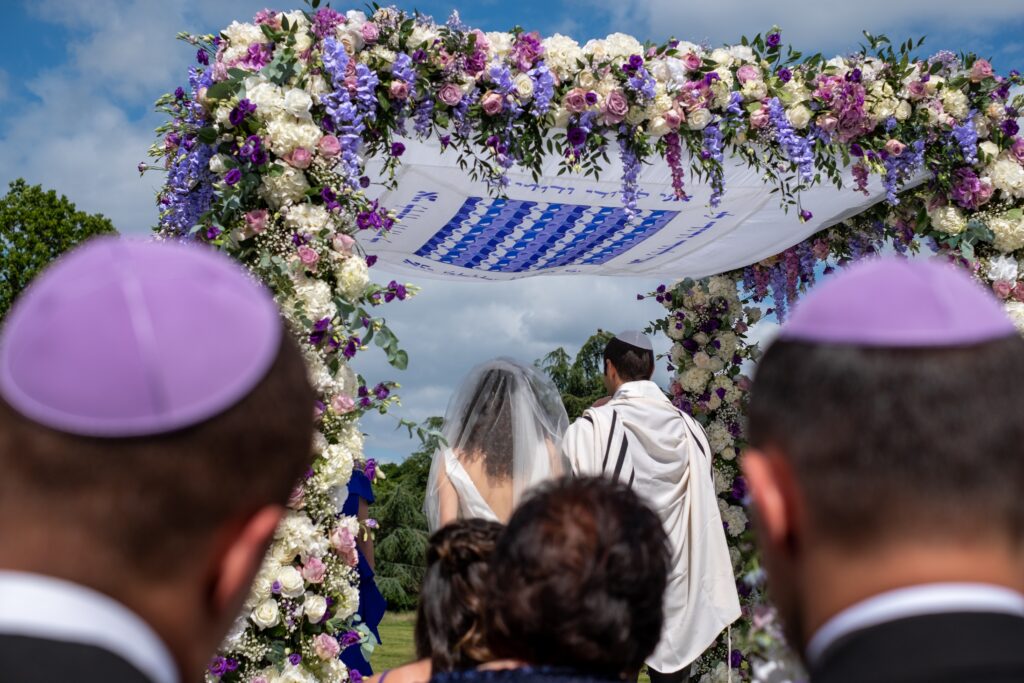
Jewish wedding ceremonies take place under a canopy called a ḥuppa. This symbolises both the home that the couple will share, as well as God’s protection over them. This canopy is so important that the whole wedding ceremony is often referred to as a ḥuppa.
There are many traditional and symbolic elements to the ceremony.
It often begins with the bride walking around the groom in 3 or 7 circles. Some people say this is to create a spiritual wall of protection from evil and negativity. Others believe the bride is symbolically creating a new ‘family circle’. 7 blessings are said, often by family members and friends to wish the couple well, then wine is blessed and passed from parents to their new children-in-law to welcome them into the family.
A ketubah is a marriage contract which contains promises as to how the couple will look after each other (including financially), which is signed during the ceremony in front of two witnesses. Many couples have beautiful and illustrated ketubahs which they frame and display on the wall in their home.
The ceremony ends with the breaking of a glass to remember the destruction of the ancient Jerusalem Temples and that even though it is a happy occasion, the world is still not yet a perfect, peaceful place.
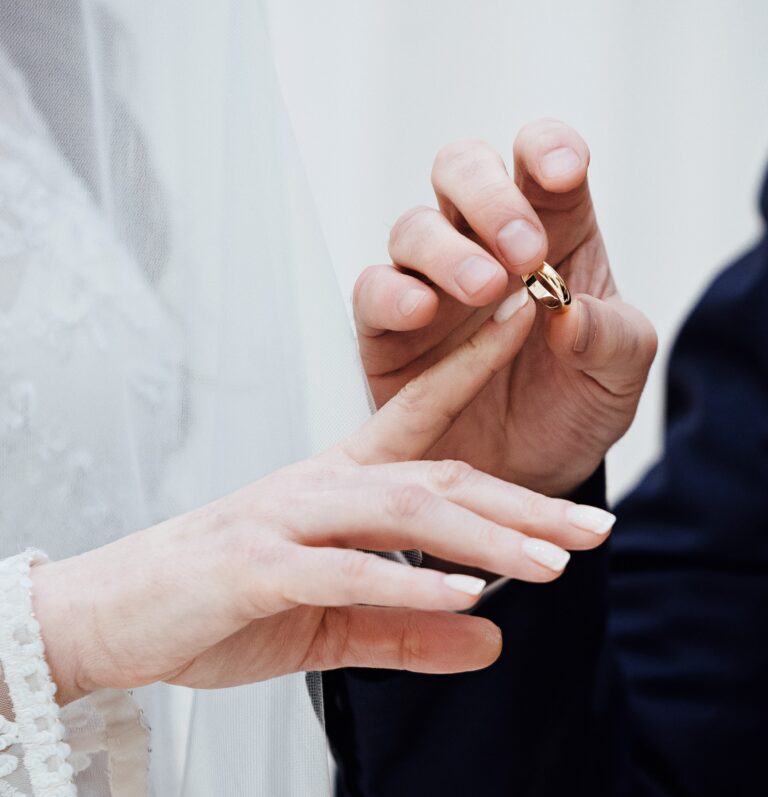
Wedding rings are placed on the index finger. This is because the vein from that finger goes right to your heart, but also because it is the strongest digit and therefore the ring could be refused if it were a forced marriage.
Same-sex marriages take place in MasortiAn ideology within Judaism (see ‘Groups within Judaism’ page for more details)., ReformAn ideology within Judaism (see ‘Groups within Judaism page for more details). and LiberalAn ideology within Judaism (see ‘Groups within Judaism page for more details). communities, but not in Orthodox communities.
TO FIND OUT
1. Are all Jewish ketubahA Jewish marriage document. documents the same?
2. What does the HebrewThe language of the Jewish people and of Israel. Hebrew is also used more generally to mean the culture of the Jewish people (ie. Hebrew calendar). phrase ‘mazal tovCongratulations. (Literal translation means ‘you have had good fortune’.)!’ mean?
CRITICAL THINKING
1. Judaism (and other faiths) consider a wedding to be a religious ceremony. For people who do not follow a faith, is marriage as important?
2. Think of two advantages and two disadvantages of using a ‘matchmaker’ to help you find someone to marry.
3. Do you think it is important to be in a relationship with or marry someone who has the same religious/non religious beliefs as you?
DID YOU KNOW?
1. A Jewish pre-wedding tradition is for a couple to not see each other for a week before the wedding. This makes it extra special when they do see each other!
2. The ḥuppaA wedding canopy. Sometimes the word refers to the whole marriage ceremony. (canopy) is sometimes made using a tallit (prayer shawl) held up by four people.
3. Traditionally matchmakers were used in Jewish families to find a ‘suitable’ person to marry. In OrthodoxOne of the major branches of Judaism. communities, they are still used widely.
4. Tuesdays are seen as a good day to get married, because in the description of Creation, God calls the day ‘good’ not just once like the other days, but twice!
CHECK YOUR KNOWLEDGE
1. What is a ḥuppa?
2. How many blessings are said as part of the wedding ceremony?
3. What is signed as part of the wedding ceremony?

