The Dreyfus Affair
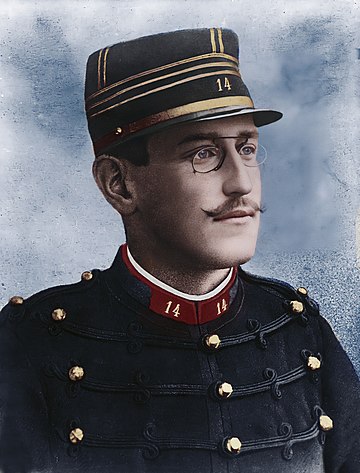
In 1894, Alfred Dreyfus – a Jewish captain in the French army – was accused of treason for allegedly passing military secrets to Germany. Despite the lack of evidence, Dreyfus was accused of “colluding with a foreign power” (working with the enemy). This fed popular racist attitudes that French Jews were not truly loyal to France. Dreyfus didn’t stand a chance as he was not given a fair trial.
Even though evidence pointed to another army officer (Major Ferdinand Walsin Esterhazy), Dreyfus was convicted of treason and given a ‘dishonourable discharge‘ (sacked) from his position in the army that he had worked so loyally for. At a public ceremony in Paris to embarrass him, Dreyfus tried to prove his loyalty to France shouting: “I swear that I am innocent. I remain worthy of serving in the army. Long live France! Long live the army!” However he was sent to a prison on ‘Devil’s Island’ where there were very harsh living conditions.
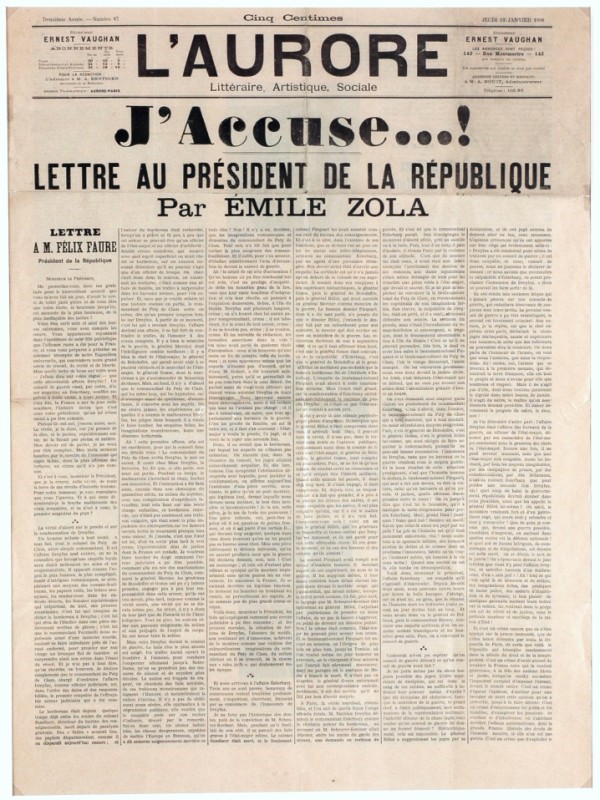
In 1898, one of France’s most famous writers, Emile Zola, published an open letter to the president of France titled “J’accuse…!” This accused the French army, government, media and society of a cover-up, and unfairly persecuting the innocent Dreyfus. Zola’s plea for justice started public debate across the world and exposed the antisemitism within French society. But Zola himself was then put on trial…
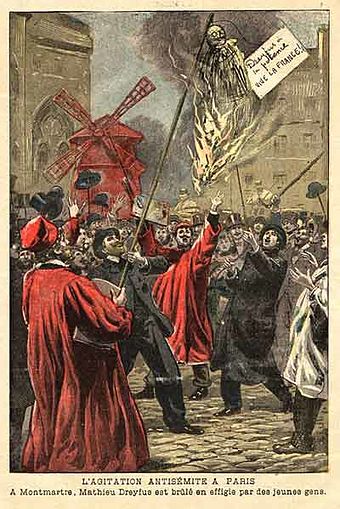
Antisemitic riots swept all over France after Zola’s trial and verdict, fed by conspiracy theories in leaflets, posters, and newspapers – blaming Jews for war defeats and economic and social problems in France.
Violent gangs took to the streets and public hate speeches were made. Riots even spread to other countries ruled by France like Algeria, where Jews were attacked on the streets and Jewish-owned businesses were raided.
One journalist reported: “Individuals with Jewish features were grabbed, surrounded, and roughed up by delirious youths who danced round them, brandishing flaming torches, made from rolled-up copies of L’Aurore” (the newspaper where Zola published J’Accuse…!).
Eventually Major Esterhazy confessed to the crime and Dreyfus’ name was cleared. However it took years for his life to return to what it had been. Despite justice being restored, a huge amount of damage had been done to the Jewish community. Years of conspiracy theories and encouragement to be racist against Jewish people was difficult to undo. Jews everywhere debated what to do…
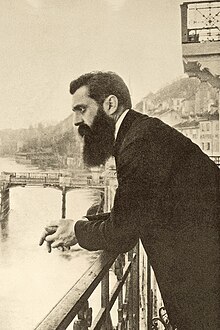
One of those Jews was Theodor Herzl, a young journalist from Austria. He had been in Paris reporting on the Dreyfus case and thought that Jewish life in Europe was in danger. He realised that the Jews needed a safe homeland. He began a movement to establish a Jewish state in the ancestral homeland of the Jewish people – the Land of Israel. He called it ZionismThe idea that Jews have the right to rule themselves in their ancient homeland..
CRITICAL THINKING
1. Do you think the blame for a crime could be falsely put on someone else in the UK today, or is the court system in the UK totally fair?
2. Do you think Theodor Herzl was right, that the solution to antisemitismHostility to or prejudice against Jews as individuals or as a collective. was for Jews to live in a separate, self-governed country?

CHECK YOUR KNOWLEDGE
1. What was the French Jew Alfred Dreyfus accused of?
2. How did Dreyfus react to being wrongly found guilty?
3. What effect did the Dreyfus case have on Theodor Herzl?