Eastern European Immigration
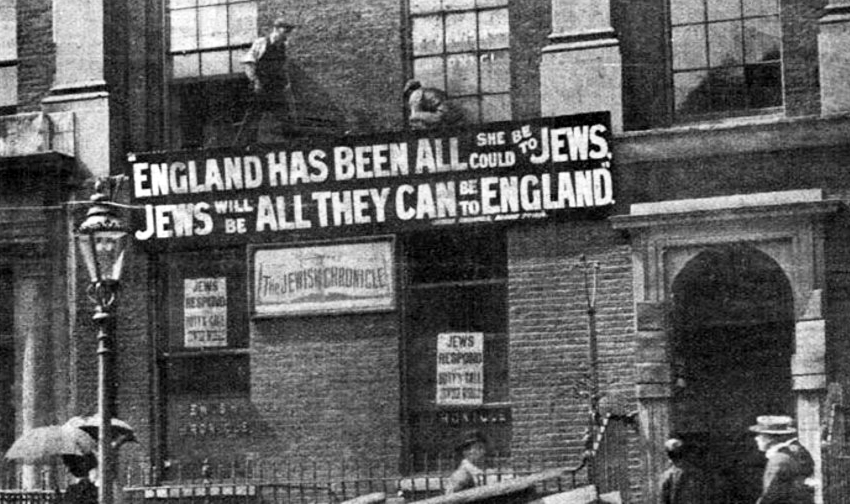
The fourth wave of Jewish immigration came in the 1880s. Sparked by war and violent antisemitismHostility to or prejudice against Jews as individuals or as a collective. in the Russian Empire, Jews from all over Poland, Ukraine, Lithuania, and other parts of Eastern Europe fled from their countries. Many of the immigrants were heading to America and travelled through Britain to get there, but a large number stayed and settled in Britain. As well as coming from Eastern Europe, Jews also came from the Ottoman Empire, today Turkey, Syria, and Iraq. This radically changed the Jewish community, increasing it to five times its previous size by 1919.
These Jews, mostly poor refugees, settled where work or cheap housing was available: in the East End of London, in the Leylands in Leeds, Red Bank in Manchester, the Gorbals in Glasgow, as well as many other smaller communities throughout the country – many of which no longer exist.
This wave of immigration only slowed after the passing of the 1905 Aliens Act – the first permanent control on immigration in British history (which stopped ‘undesirable immigrants’ from being allowed to enter Britain, and defined which refugees would be allowed to enter) and the start of the First World War in 1914. As equal members of British society, many Jews signed up or were conscripted into military service during the First World War.
TO FIND OUT
1. What has the famous ‘British’ dish fish and chips got to do with Jewish immigration?
2. What laws are there today about immigration to the UK? Do you think they are fair or would you change them?
3. Where have most immigrants to Britain come from in the last five years?

CRITICAL THINKING
Do you think immigrants to a country should have to agree to fight in that country’s army if there was a war?
CHECK YOUR KNOWLEDGE
1. Why did many Jews move from the Russian empire to England?
2. What other countries did Jews come from (in the Ottoman Empire)?
3. Why was it harder to move to England after 1905?