
The Talmud
The Oral law is very important as it helps to explain the written TorahThe Jewish holy book (bible).. For example, the commandment of ‘do not kill’ may seem quite straightforward, but what about if you have to defend yourself if your life is in danger? The Oral law tradition describes exactly how the 613 laws in the TorahThe Jewish holy book (bible). scroll should be kept.
When the second Jewish TempleA huge complex that stood in Jerusalem. It was the centre of Jewish religious life from about 1200 BCE – 70 CE. in Jerusalem was destroyed, the Jewish people had to spread out and live in different countries. There was a great fear that the Oral law would be lost. Therefore it was eventually written down and named the MishnaThe Oral Law, eventually written down..
This meant that the Oral law could be passed from one generation to the next, without worrying that it would get forgotten or changed…

Even with the extra information and examples in the Mishna, many rabbis disagreed about exactly how to interpret and carry out some of the Torah laws. These discussions (or polite arguments!) were all logged in another book called the GemaraA collection of writings discussing the Mishna..
The Mishna and GemaraA collection of writings discussing the Mishna. together are known as the Talmud.
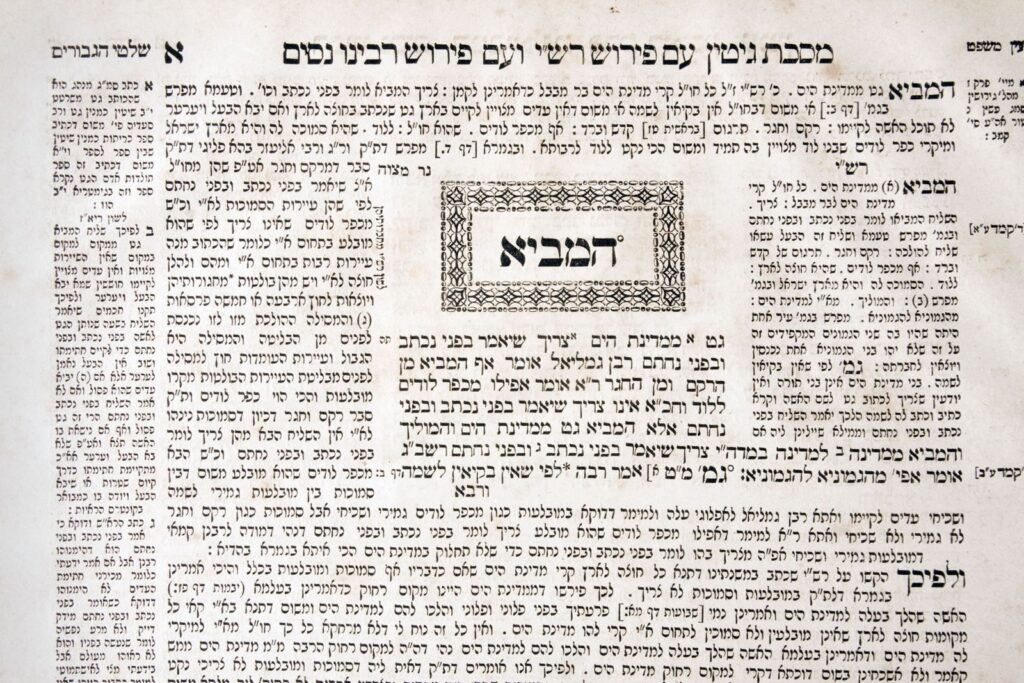
Pages of Talmud are laid out in a particular format, which you can see in the image below. At the top is the chapter name and number. In the middle is the Mishna text (Oral law) followed by the GemaraA collection of writings discussing the Mishna. (discussion of it). The right side shows explanations by Rashi (a great rabbi from the 11th century) and on the left are ‘Tosafot‘ (additional comments) by other rabbis from the 12th and 13th centuries. On the edges you will find references to Torah text, as well as definitions of words and references to other linked ideas by rabbis from the 17th and 19th centuries.
TO FIND OUT
The TalmudA collective name for the Mishna and Gemara together. contains many stories of RabbiMeaning teacher. A spiritual leader of a community. Rabbis study for years and take the ‘smeiha’ exam to gain the title of rabbi. Hillel and RabbiMeaning teacher. A spiritual leader of a community. Rabbis study for years and take the ‘smeiha’ exam to gain the title of rabbi. Shamai, who famously argued about the best way of doing different things in order to lead a good Jewish life. Find an example of something they disagreed about.
CRITICAL THINKING
1. What are the pros and cons of writing down a tradition that has been passed down by word of mouth for many years?
2. Do you think it’s possible to disagree with someone (like the rabbis in the Gemara) and still maintain a friendship and mutual respect?
DID YOU KNOW?
You can now find the whole Talmud online and even on apps!
CHECK YOUR KNOWLEDGE
1. What is the ‘Oral lawJewish tradition and law passed down orally from generation to generation. (Eventually written down as the ‘Mishna’.)’ for?
2. If the ‘Oral law’ is ‘oral’, why was it written down?
3. Why has the Talmud got many sections written by different people?

