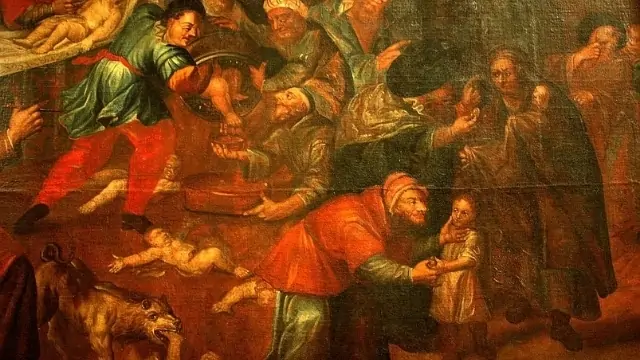
An 18th-century painting of the blood libel in the cathedral of Sandomierz, Poland.
A false belief that Jews were to blame for Jesus’ death took root in the Christian world. Medieval Christian society expanded this idea to further label Jews as diabolically wicked. When people are taught from birth that Jews are an evil, demonic people who killed God, it’s not difficult to get them to believe all manner of terrible false facts about Jews.
People throughout Europe came to believe the lie that Jews killed and used the blood of Christian children for Jewish rituals. This accusations were called ‘Blood libels‘ and would often come around the time of PassoverThe festival of Passover. (when Jews bake special flat bread called matzahFlat (unleavened) bread eaten on Passover, made of just flour and water.). As PassoverThe festival of Passover. is also around the same time as Easter each year, Christian communities were taught to hold Jews responsible for Jesus’ death. They would act out the events of the crucifixion in elaborate Passion plays, which made the antisemitic myths easier to believe.
The first known case of a blood libel was in 1144. A 12-year-old boy called William of Norwich was found murdered. His tragic death was unexplained and the community were unable to find any evidence as to who might have killed him. But, just four years later, a monk by the name of Thomas of Monmouth visited Norwich where he claimed that the Jews of the town had tortured and killed William in the same way as Jesus was crucified – by “fixing him to a cross in mockery of the Lord’s Passion.” The town’s Jews were forced to seek safety in Norwich Castle.
Tales of Jewish ritual sacrifice of Christian children quickly spreadthroughoutEngland, Europe and parts of the Middle East. These accusations were almost always followed by intense persecution, attacks, looting, expulsion, and murder of Jews in the local community. In England, blood libels led to murderous riots in London, Gloucester, Bury St Edmonds, Lincoln and York.
In 1190, 150 Jews were attacked in York and then massacred when they took refuge in the royal castle, where Clifford’s Tower now stands. Some killed themselves rather than be taken by the mob. Within 100 years from the York massacre, the blood libel and other antisemitic myths had so taken hold in England that all of the country’s Jews were expelled by Edward I in his Edict of Expulsion in 1290. Jews would not return to Britain until 300 years later.
The massacre of 150 Jews in York in 1190 took place on the site of what is now Clifford's Tower.
Plaque at the base of Clifford's Tower commemorating the riot.
Christian influences from Europe probably inspired the blood libel myths that began in the Middle East. In 1840, a notorious case in Ottoman Syria, known as the Damascus Affair, involved a Christian monk and his Muslim servant who went missing, which led to anti-Jewish violence and riots. In 1910, 12 Jewish people were murdered in Iran when a blood libel accusation led to frenzied protests and mass looting.
Blood libel accusations have continued throughout history. One of the most infamous was in 1475 in Trento, Italy, that led to the arrest and torture of the local Jewish community and the execution of eight innocent men. The charge of blood libel in this case wasn’t dismissed by the Church until 1950. As late as 1915 in Russia, Menahem Beilis stood trial for an invented ‘ritual murder’ accusation. One characteristic of modern antisemitismHostility to or prejudice against Jews as individuals or as a collective. is that age-old tropes get recycled, and can often be seen in fanatical anti-Israel rhetoric, with some people still believing that Jews bake matzah with Christian blood to this day.
Of course, murder is forbidden in Jewish law, but what makes the blood libels so ironic is that consuming any kind of blood is forbidden by the laws of kashrut (kosher‘Suitable’ or ‘fit’ according to Jewish law, often used to describe permitted foods. food).
CRITICAL THINKING
Why do you think people believed the blood libels? Were the general public more gullible (easily persuaded) in the past than we are today?
CHECK YOUR KNOWLEDGE
1. Who were Jews supposedly killing?
2. What were Jews supposedly doing with the blood of these murdered people?
3. Why were the blood libels more common around the time of Easter?