
The Torah & Tanaḥ
The main and most special text for Jews is the Torah (meaning the ‘teaching’ – wisdom that should be passed down). So what is the Torah made up of and where did it come from?
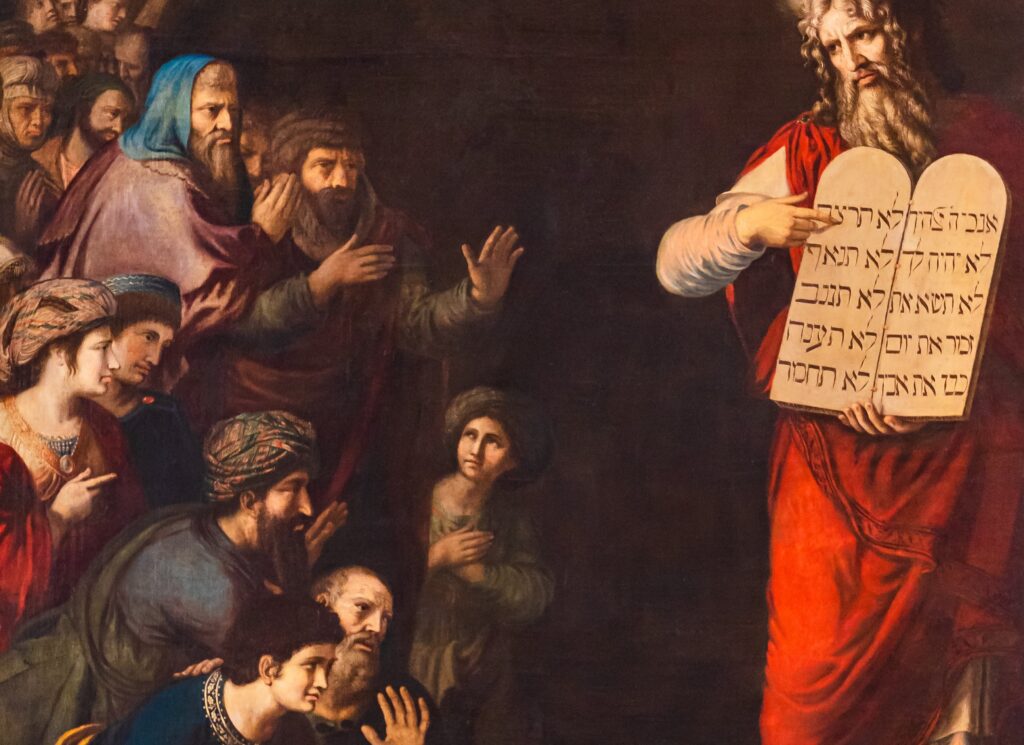
The OrthodoxOne of the major branches of Judaism. tradition tells of Moses writing down the exact word of God as it was revealed to him on Mount Sinai (in the year 1312 BCE). This is why the Torah is often called ‘The Five Books of Moses‘. With this written Torah came explanations and more detail, known as the ‘Oral lawJewish tradition and law passed down orally from generation to generation. (Eventually written down as the ‘Mishna’.)’ (which was eventually written down too).
Other groups within Judaism have slightly differing views of exactly how the Torah came into being, but believe that it was divinely inspired, rather than the exact word of God. Therefore, non-Orthodox groups are more open to adapting laws and interpreting them to suit the needs of a modern society – some slightly and some more radically.
The Torah begins with the story of the creation of the world. It then runs through the family tree from Adam and Eve through to Abraham, the ‘first Jew’ and his wife Sarah. It continues with a potted history of their descendants, travels and experiences, until they returned to live in Israel as a large nation.

The Torah is split into five ‘books’ – known as Bereshit (Genesis), Shemot (Exodus), Vayikra (Leviticus), Bamidbar (Numbers) and Devarim (Deuteronomy).
The Torah also includes many mitzvotPlural of mitzvah (commandments or laws) on a wide variety of topics – a guide to life. The ‘Ten Commandments’ are very famous, but these are only ten of the 613 laws in the Torah! These include how to treat others (including your spouse), what to eat, ShabbatThe Jewish sabbath day (Friday evening to Saturday evening). Sometimes pronounced ‘Shabbos’ by Ashkenazi Jews. and festival observance, agricultural law, and what to do if people get hurt or property gets damaged.
As if this wasn’t enough to get your teeth into, there are many other important Jewish texts. Together, many of these key, ancient texts are grouped together as the ‘Tanaḥ’. This is an acronym for Torah, Nevi’im (writings of the Prophets) and Ketuvim (other writings – including the Book of Psalms and the Books of Esther, Ruth, and Jonah).
TO FIND OUT
1. Christians call the Tanaḥ the ‘Old Testament’ but Jewish people do not use that name for it. Why not?
2. All the prophets included in the Book of Prophets in the Tanaḥ are male. Judaism does have seven female prophetesses. Who are they? Why do you think they were not included in the Book of Prophets?
CRITICAL THINKING
1. If there is a special guide book to life that many people agree is full of wisdom, does it make a difference if it is divine (from God) or written by humans?
2. The ‘Ten Commandments‘ as they are generally referred to in English, are known in HebrewThe language of the Jewish people and of Israel. Hebrew is also used more generally to mean the culture of the Jewish people (ie. Hebrew calendar). as the ‘Aseret HadibrotThe Ten Commandments – (literally translates as the ten sayings or ten utterances)‘, meaning the ‘ten utterances‘ or ‘ten sayings‘. Why is this a more accurate description?
3. Are the Ten Commandments relevant to all humans? If you think not, come up with a list of ten good rules for life which you believe would be relevant for all people.
DID YOU KNOW?
1. Many of the laws from the Torah are to do with the running of the Temple in Jerusalem, which means they cannot currently be kept by any Jews.
2. About half of all TorahThe Jewish holy book (bible). laws are only relevant for Jews living in the land of Israel, one example being keeping the ‘shmita’ year (an agricultural law to leave land and crops to rest every seventh year). These laws can’t be kept by Jews living in the diaspora (outside of Israel).
3. The tablets of stone are often described and depicted as rounded arch shapes (as in the painting above), but according to Jewish tradition, they were rectangles, with sharp corners!
CHECK YOUR KNOWLEDGE
1. Is the whole Torah thought to be the direct word of God by Jews?
2. Jewish tradition tells of the Torah being given to the IsraelitesThe descendants of Jacob (who was known as Israel). The name ‘Jewish people’ is used for the Israelites after they received the Torah. with the help of which leader?
3. The TanaḥA collective name for the Torah, books of the prophets and other important Jewish texts. is an umbrella name for 3 types of texts. What are they?

