
The Jewish Calendar
The HebrewThe language of the Jewish people and of Israel. Hebrew is also used more generally to mean the culture of the Jewish people (ie. Hebrew calendar). calendar is luni-solar – meaning that it follows the pattern of both the moon and the sun. There are 12 months with HebrewThe language of the Jewish people and of Israel. Hebrew is also used more generally to mean the culture of the Jewish people (ie. Hebrew calendar). names and each has 29/30 days tracking the new moon. This means that the HebrewThe language of the Jewish people and of Israel. Hebrew is also used more generally to mean the culture of the Jewish people (ie. Hebrew calendar). year is 11 days shorter than the Gregorian/solar year! However, there are leap years (7 every 19 years) where a whole extra month is added to keep in line with the seasons, so that Jewish festivals always fall at the right time of year!
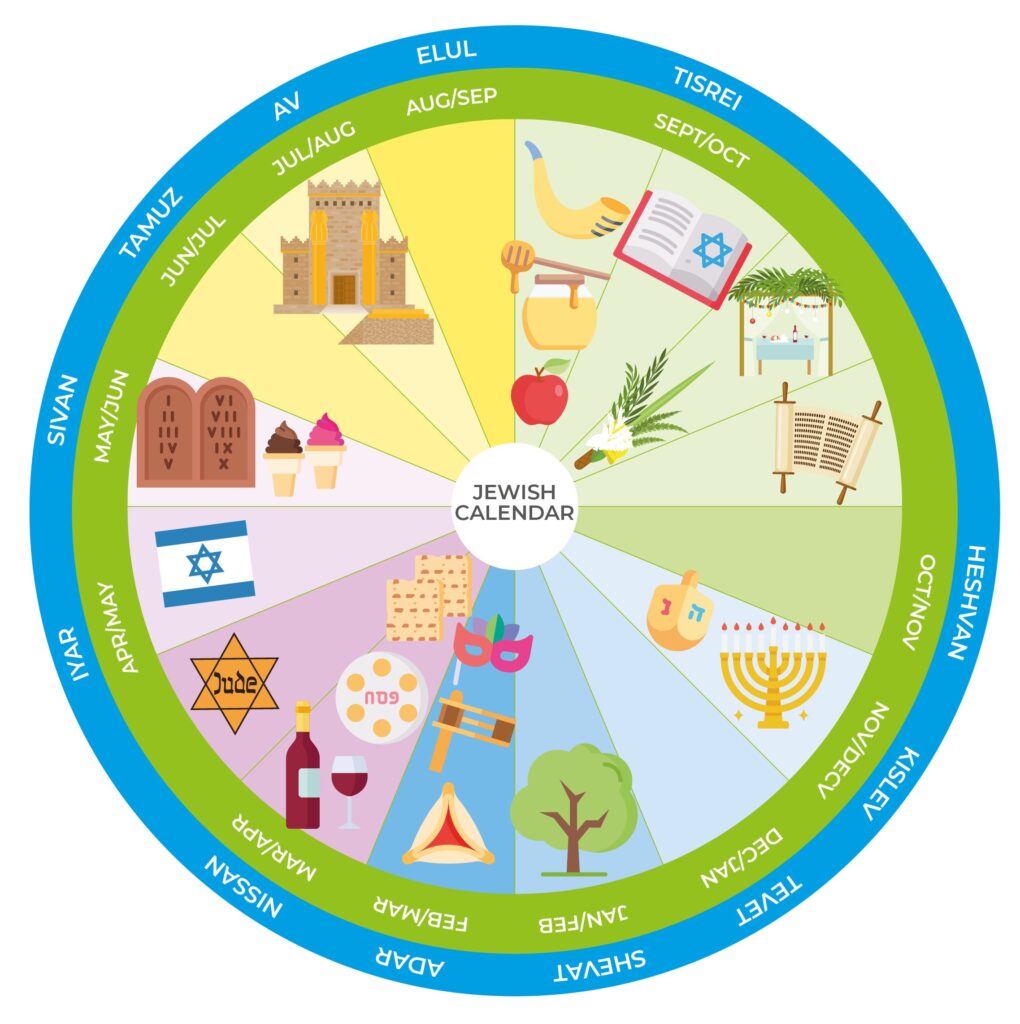
Jewish days run evening to evening, not midnight to midnight. This originates from the Torah’s description of the days of creation where evenings come first: “There was evening and there was morning…” (Genesis 1) This is why the sabbath and all Jewish festivals begin at sundown.
“I love the way my year is structured around not just the four seasons, but also the Jewish festivals. It’s great to have different things to celebrate and think about throughout the year, as well as always having the next festival to look forward to.
The Jewish new year – Rosh HashanaThe Jewish new year. (Literally translates as ‘Head of the year’.) – is around the same time of year as the new school year. I feel like that really helps me as I can start afresh every autumn, academically and emotionally. My family follow the Jewish calendar as well as the regular one, so we have a Jewish calendar on the wall in the kitchen.
It helps me to coordinate what’s going on at school, with my football team or going out with friends, making sure they don’t clash with important Jewish events and festivals. As we follow both the Western calendar and the Jewish calendar, my little sister loves the fact that she can celebrate her birthday twice each year!”
– Edden, (16) Liverpool
There are many festivals and special days that punctuate the Jewish year. Most were laid out in the Torah, for example Rosh HaShana, Yom KippurThe day of atonement. An annual date set by the Torah., PesaḥThe festival of Passover., Shavuot and SukkotThe autumn festival of booths/huts..
Tu B’ShvatThe Jewish new year for trees. is a festival mentioned in the MishnaThe Oral Law, eventually written down. (Oral lawJewish tradition and law passed down orally from generation to generation. (Eventually written down as the ‘Mishna’.)). Other religious festivals were introduced into the Jewish calendar after the writing of the Torah (i.e. ḤanukahThe rededication of the Temple festival (Festival of lights)., PurimThe festival celebrating the survival of Jews in Persia. (Literally translates as ‘drawing lots’.) and Simḥat TorahA festival in Autumn, celebrating completing reading the whole Torah, and starting again at the beginning.).
There are also a couple of recent editions to the list of special days such as Yom HaShoahHolocaust memorial day (Holocaust Memorial Day), Tisha B’AvThe 9 of the month of Av (which commemorates the destruction of the Temples and other sad occasions). (the ninth of Av) and Yom Ha’Atzmaut (Israeli Independence day).
Hebrew Date Converter
Enter a Gregorian calendar date on the left or a Hebrew calendar date on the right to convert between the two systems.
TO FIND OUT
1. Why do many Jews living in the diaspora (outside of Israel) celebrate most of the festivals (for example ShavuotThe festival of weeks – celebrating the giving of the Torah.) for two days, when the TorahThe Jewish holy book (bible). says they are one day long?
2. The Islamic Calendar (also known as the Hijri Calendar) is lunar rather than luni-solar. What are some other differences between the two calendar systems?
CRITICAL THINKING
Jewish people have a birthday date according to the Gregorian calendar and the Jewish calendar. These fall on different days each year. Which one do you think they should use to celebrate their birthday each year and why?
DID YOU KNOW?
The month of ‘Ḥeshvan‘ is often called ‘Mar-Ḥeshvan‘ (meaning bitter Ḥeshvan), as it has no festivals to make it special!
CHECK YOUR KNOWLEDGE
1. What is the name for the type of calendar which follows both the moon and the sun?
2. Do Jewish festivals always fall in the same seasons every year?
3. Are all Jewish festivals and special days talked about in the Torah?

