Timeline

17th Century BCE

Jewish Patriarchs and Matriarchs
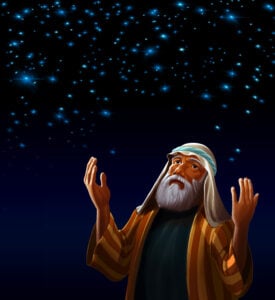
Abraham and Sarah, Isaac and Rebekah, Jacob (known as Israel), Leah and Rachel and their children (which is four generations) live in Canaan (today’s Israel). They are known as the ‘Israelites’. Famine forces them to move to Egypt temporarily, but they become enslaved by a new pharaoh for over 200 years.

Illustration of Moses

17th Century BCE

13th Century BCE

Moses & Exodus

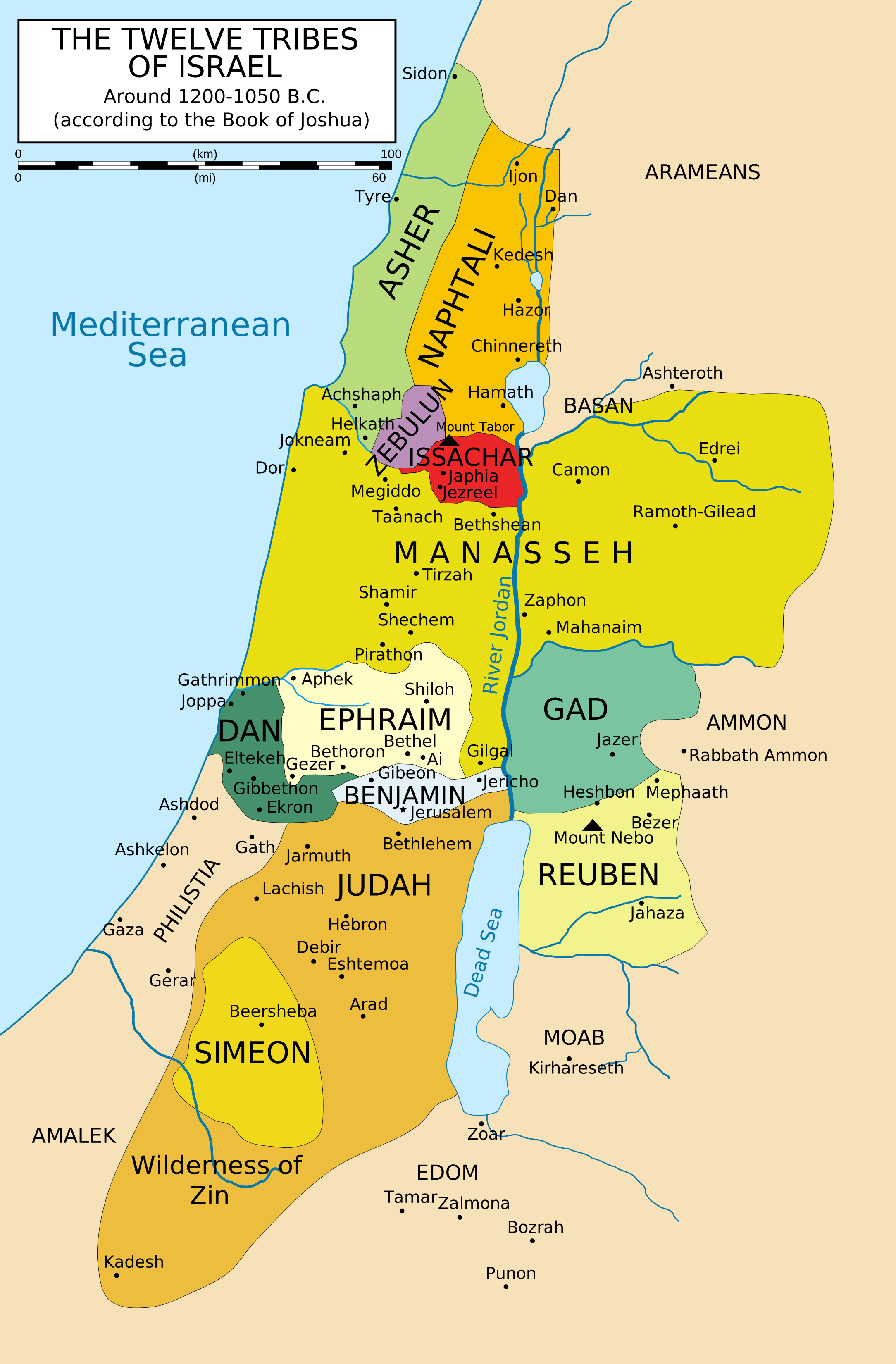
Exodus from Egypt: Moses leads the Israelites (now a large nation) out of Egypt. They travel through the desert for 40 years, eventually arriving back in Canaan (Israel), where they settle, each tribe (family group) living in a different area.
12 Tribles of Israel Map
12 Tribes of Israel Map
13th Century BCE

1020 BCE

King Saul

An Israelite monarchy is established. Saul is crowned the first king.
1020 BCE

1000 BCE

King David

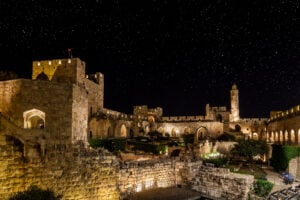
King David (the second king) makes Jerusalem the capital of the kingdom.
1000 BCE

960 BCE

First Temple Built

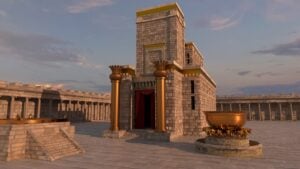
The First Temple, the national and spiritual centre of the people of Judea is built on Mount Moriah in Jerusalem by King Solomon (King David’s son).
960 BCE

930 BCE

Two Kingdoms

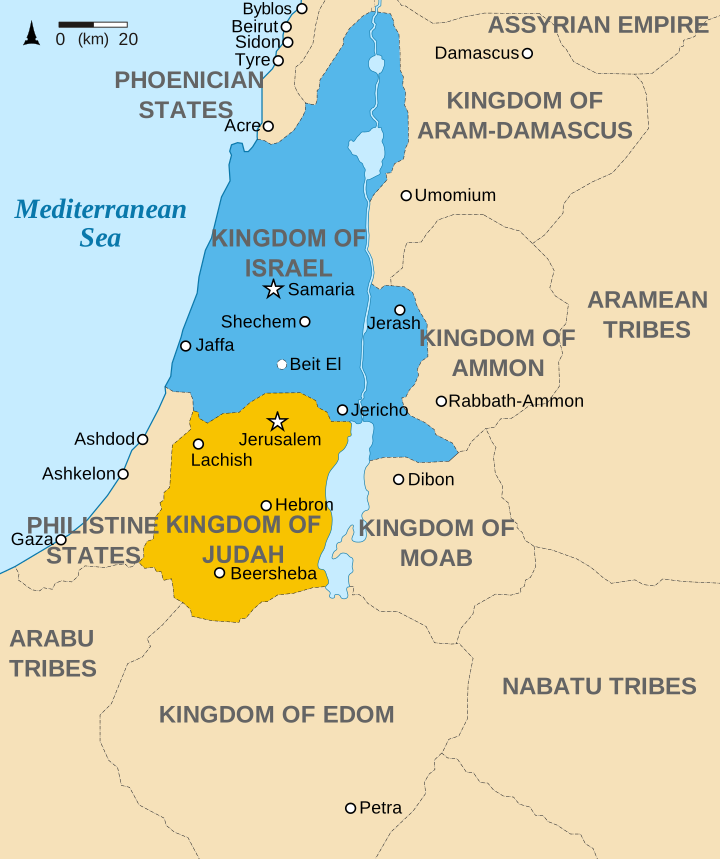
After Solomon’s death, the country divides into two: the Kingdom of Israel (containing Samaria) in the north, where 10 tribes live and the Kingdom of Judah (containing Jerusalem) in the south, where the other two tribes live.
Map of Kingdoms of Israel and Judea
Map of Kingdoms of Israel and Judea and surrounding states.
930 BCE

720 BCE

The Lost Tribes

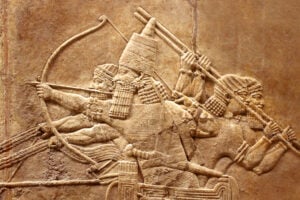
The northern kingdom is conquered by the Assyrians. Many thousands of Jews are transported to distant provinces of the Assyrian empire. These are known as the ‘lost tribes’.
Assyrian stone relief carving.
720 BCE

586 BCE

First Temple Destruction & Babylonian Exile
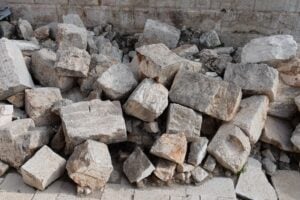
The Kingdom of Judah (including Jerusalem) is conquered by the Babylonians. After a 30-month siege  of Jerusalem. The Temple is destroyed (along with most of Jerusalem) and most people are forced out to Babylon.
Debris remnants from the destruction of the temple in Jerusalem.
586 BCE

538–515 BCE

Return from Exile & Second Temple
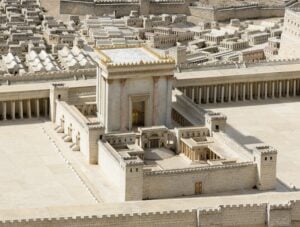
The Jews of Judah are allowed to return from Babylon, when Persian ‘Cyrus the Great’ conquers Babylonia. The Temple is rebuilt.
Model of the original Second Temple structure.
538–515 BCE

166–160 BCE

Maccabean Revolt

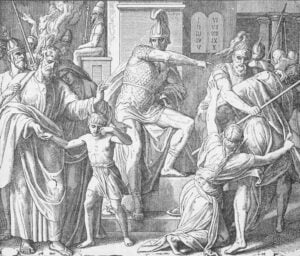
The Seleucid Greeks rule Jerusalem. Huge restrictions are placed on the practice of Judaism and the Temple is desecrated. A group of Jews (The Maccabees) revolt – the story of Hanukah.
Illustration of Persecution of the Israelites by Antiochus.
166–160 BCE

129–63 BCE

Jewish Independence

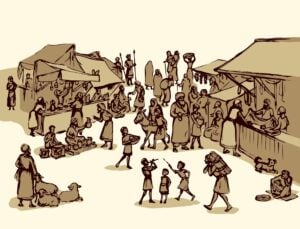
Jewish independence in Judea is restored. Jewish life flourishes.
Illustration of village life in Judea.
129–63 BCE

63–4 BCE

Roman Rule

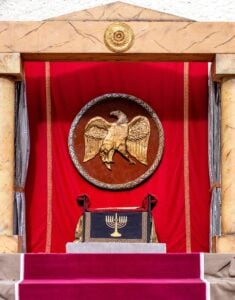
Jerusalem is captured by Roman General Pompey. The Romans rule the Land of Judea and relations between the Romans and Jews are complicated. Herod, a Jew, is appointed King of Judea by the Romans! He expands the Jewish Temple complex in Jerusalem.
King Herod's throne (recreation)
King Herod’s throne (recreation)
63–4 BCE

66–70

Jewish Revolt & Second Temple destroyed
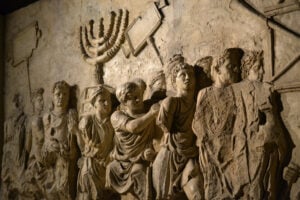
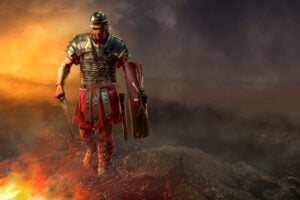
Over time relations between the Jews and Romans deteriorates. The Jews eventually revolt against the Romans. The Romans kill many Jews, destroy the city of Jerusalem and The Temple. Many Jews leave Judea in order to continue practicing Judaism. Treasures from the Temple are taken to Rome.
Carving on the Arch of Titus showing items being taken from the Temple.
66–70

73

Masada

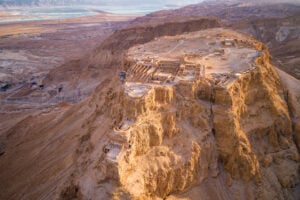
Nearly 1,000 Jews flee to Masada (a desert fortress built by King Herod). According to historian Josephus, following a siege, the Jews kill themselves rather than be killed by the Romans.
Aerial view of Masada ruins near the Dead Sea.
Aerial view of the ruins of King Herod’s castle at Masada near the Dead Sea.
73

132–135

Bar Kokhba Revolt

Simon bar Kokhba leads the remaining Jews in another uprising against the Romans, but do not win. Many Jews are enslaved and killed. The Romans change the names ‘Judaea’ to ‘Syria Palaestina’ and ‘Jerusalem’ to ‘Aelia Capitolina’. Most Jewish survivors move to the Galilee (north) which became the religious centre.

Painting of Bar Kochba

132–135

200

Mishna – Jewish Oral Law completed

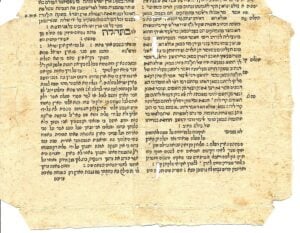
With so many Jews now living dispersed around the world, the Jewish Oral Law,  ‘the Mishna’, is written down to stop it being lost.

200

390

Jerusalem Talmud completed

The commentary – ‘Gemara’ – on the Mishna is completed in the Galilee area. (Another more substantial version of the Talmud, which most Jews today refer to, was written around the same time in Babylon.)

390

691

Arab Conquest

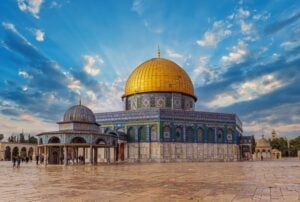
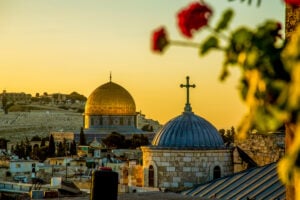
On site of the First and Second Temples (Temple Mount) in Jerusalem, the Dome of the Rock (mosque) is built by Caliph Abd al-Malik.

691

1099–1291

Crusades

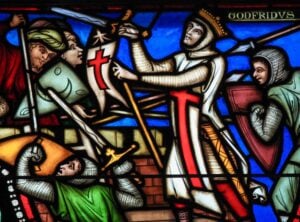
European crusaders attack and conquer Jerusalem. Many Muslims and Jews are killed. Some European Christians settle in Jerusalem.
1099–1291

1291–1516

Mamluk Rule

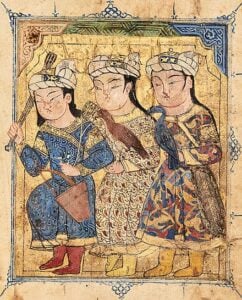
The (Muslim) Mamluks, who had just gained control of Egypt and Syria, invade and take control from the Crusaders.
Frontispiece of Sulwan al-Muta’ fi ‘Udwan al-Atba’ by Ibn Zafar al-Siqilli, Mamluk Egypt or Syria, circa 1330.
1291–1516

1517

Ottoman conquest

The Ottoman (Turkish) Empire conquers the land. This brings a period of peace. (Although the official religion of the Ottomans was Islam, Jews and Christians are ‘protected’ if loyal to the empire.) This lasts for 400 years.

1517

1860

Jerusalem Expands

Jewish population growth leads to the expansion of Jerusalem beyond the Old City walls.
1860

1882–1903

First Aliyah

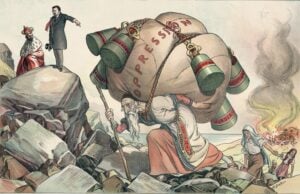
The ‘First Aliyah’ (wave of immigration) takes place – mainly from the Russian Empire.
Cartoon showing President Theodore Roosevelt asking Russian Czar Nicolas II to end oppression of Russian Jews. (Judge Company Publishers)
1882–1903

1897

First Zionist Congress

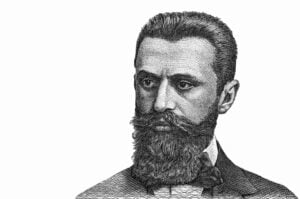
First Zionist Congress is organised by Theodor Herzl in Basel, Switzerland. The World Zionist Organization is founded.
Herzl (as pictured on Israeli bank notes)
1897

1904–1914

Second Aliyah

Due to much antisemitism and pogroms (attacks) in Russia and Poland, there is second wave of immigration.
1904–1914

1905

First Jewish School

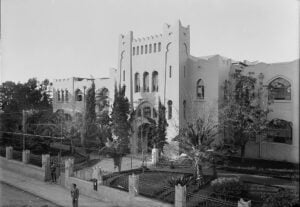
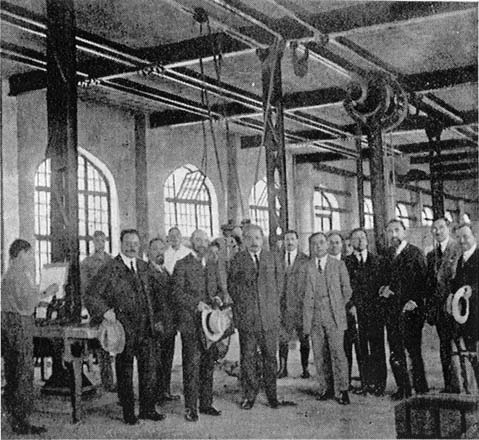
Gymnasia Herzliya, the future country’s first modern Jewish High school, was founded in 1905 in Jaffa.

1905

1909

Tel-Aviv

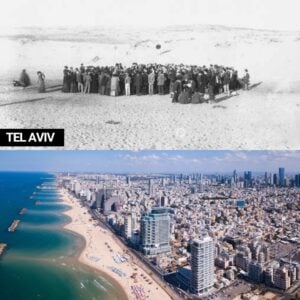
The first modern Jewish city, Tel Aviv is founded.
Tel Aviv, 1909 and 2024.
1909

1910

The First Kibbutz

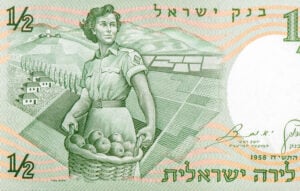
‘Degania’, the first kibbutz (socialist community where everything is shared, from money to cooking and childcare) is set up.
Pioneer kibbutz worker (on banknote).
1910

1917–18

British Rule & Balfour Declaration
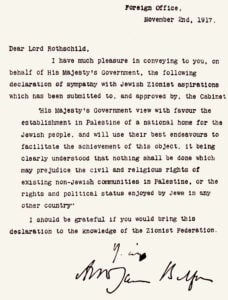
During WWI, the British take over land, which they call ‘British Mandate Palestine’. The British government issues the Balfour Declaration which promises ‘the establishment in Palestine of a national home for the Jewish people’ where ‘nothing shall be done which may prejudice the civil and religious rights of existing non-Jewish communities in Palestine or the rights and political status enjoyed by Jews in any other country’.

1917–18

1919–1932

Third & Fourth Aliyah

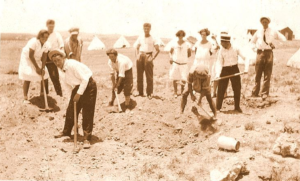
A third and fourth ‘Aliyah’ – waves of immigration occur, mainly from Eastern Europe. The fourth wave was fuelled by Jews fleeing rising antisemitism.
New immigrants working the land, 1921.
1919–1932

1920

National Jewish Organsations

The Jewish community forms:

‘Va’ad Leumi’ (National Council – later becomes the Israeli government)

‘Histadrut’ (General Federation of Labour Unions)

‘Haganah’ (later becomes the Israeli Defence Force – today’s Israeli army)
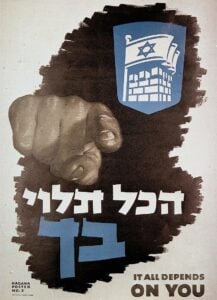
Haganah Poster

1920

1922

Mandate for Palestine

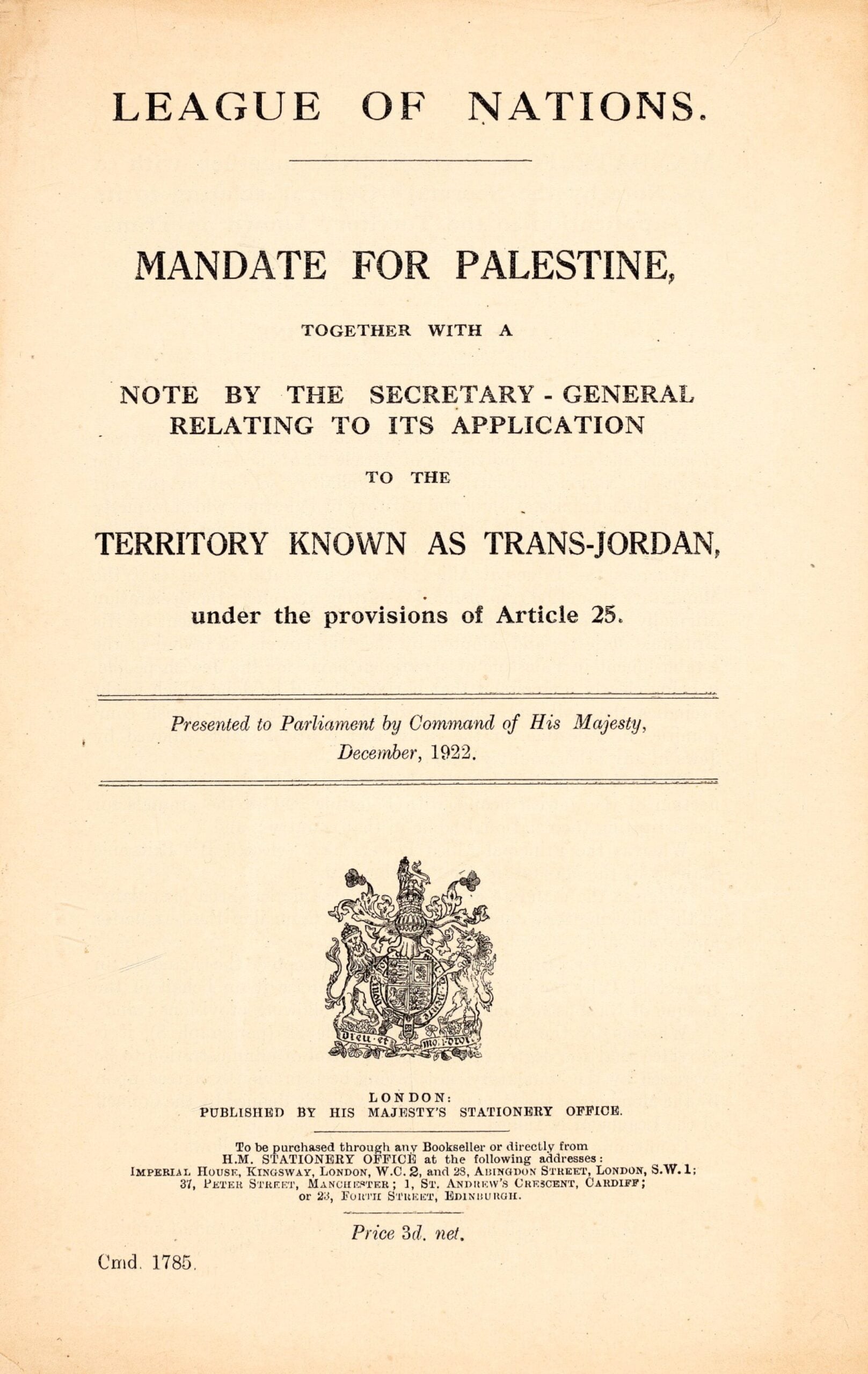
The ‘League of Nations’ (now the United Nations) approves the Mandate for Palestine – a plan to establish a Jewish state, alongside a Palestinian state. Britain promises ‘administrative advice and assistance’ until this is in place. The mandate encourages Jewish immigration.
League of Nations Mandate for Palestine
1922

1924

Technion Established

The Technion (Institute of Technology) is the first university founded by the Zionist Congress. It is one of the first universities of the Middle East and remains world renowned.
Einstein at the opening of the Technion - Haifa, 1924.
Einstein at the opening of the Technion – Haifa, 1924.
1924

1925

Hebrew University established

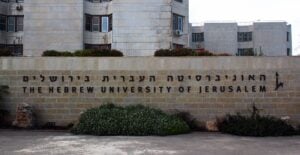
The Hebrew University of Jerusalem, Israel’s second university is established. Notable figures such as Albert Einstein and Sigmund Freud are governors. Fifteen Nobel Prize winners, two Field Medallists, and three Turing Award winners have been affiliated with the university.

1925

1929

Hebron massacre

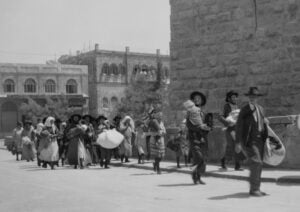
For many years, Jews and Arabs live in peace in the city of Hebron. In August 1929, three days of violence against the Jewish community occur due to tensions over the Temple Mount in Jerusalem. 67 Jews are killed and Jewish homes and synagogues are destroyed. The survivors are relocated to Jerusalem.
Jewish families fleeing from riots, 1929.
1929

1931

Irgun Formed

In 1931 the Irgun (a Zionist militant group) is formed. They commit acts of terrorism against Palestinian Arabs as well as the British authorities. The Irgun formally disbands after the State of Israel forms and has an official army – the IDF.

File:Irgun.svg

1931

1933–1939

Fifth Aliyah

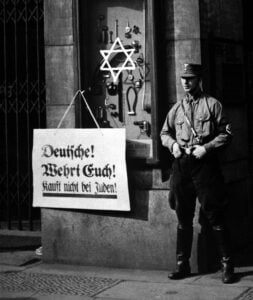
A ‘Fifth Aliyah’ (wave of immigration) occurs, mainly from Germany as Jews flee from the Nazi regime.
Anti Jewish boycott, Berlin, Germany, 1933. Sign reads: ‘Germans! Defend yourselves! Do not buy from Jews!’
1933–1939

1936–1939

The Peel Commission

The British Peel Commission recommends the partition of the country between Arabs and Jews. The Arabs reject the idea while the Jews accept it. Anti-Jewish riots are instigated.
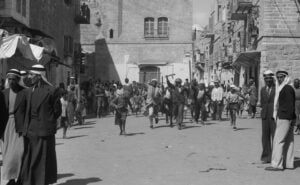
Arab youths in Bethlehem, after burning government offices during a revolt, 1938.
1936–1939

1939

British White Paper

The British government calls for the establishment of a Jewish national home in an independent Palestinian state within ten years. Due to Arab protests, Jewish immigration is limited for five years and Jews are restricted from buying land in much of the country.
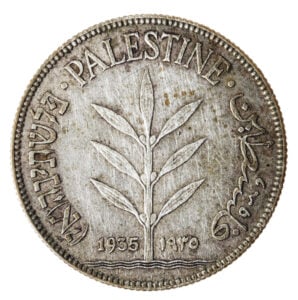
A coin from British Mandate Palestine (with Hebrew and Arabic).
1939

1939–1945

WWII & The Holocaust

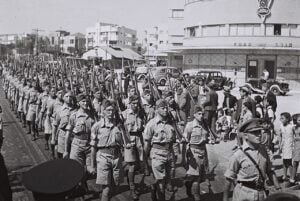
World War Two occurs. There is a Holocaust in Europe where six million Jews and many others are killed by the Nazis. In 1944 the ‘Jewish Brigade’ is formed in Mandate Palestine to send Jews to fight alongside British forces.
1939–1945

1945–7

End of WWII

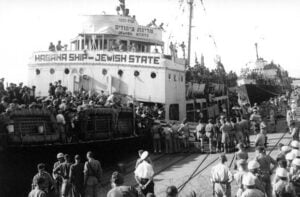
At the end of the war, the British continue their immigration restrictions and many Jewish Holocaust survivors arriving by boat to Palestine are violently turned away.
Boat of Jewish immigrants arriving at Haifa Port, Israel.
1945–7

1946

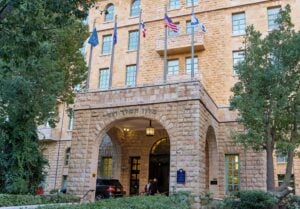
Hotel Bombing

On July 22, 1946, the Irgun (a Zionist militant group) bomb the offices of the British authorities in the King David Hotel in Jerusalem. This was in response to British troops invading the Jewish Agency Office and confiscating a lot of documents and arresting many Jews. Despite the Irgun sending three warnings by phone before the bombing, 91 people are killed, including Arabs, Britons and Jews, and 46 were injured.

1946

1947

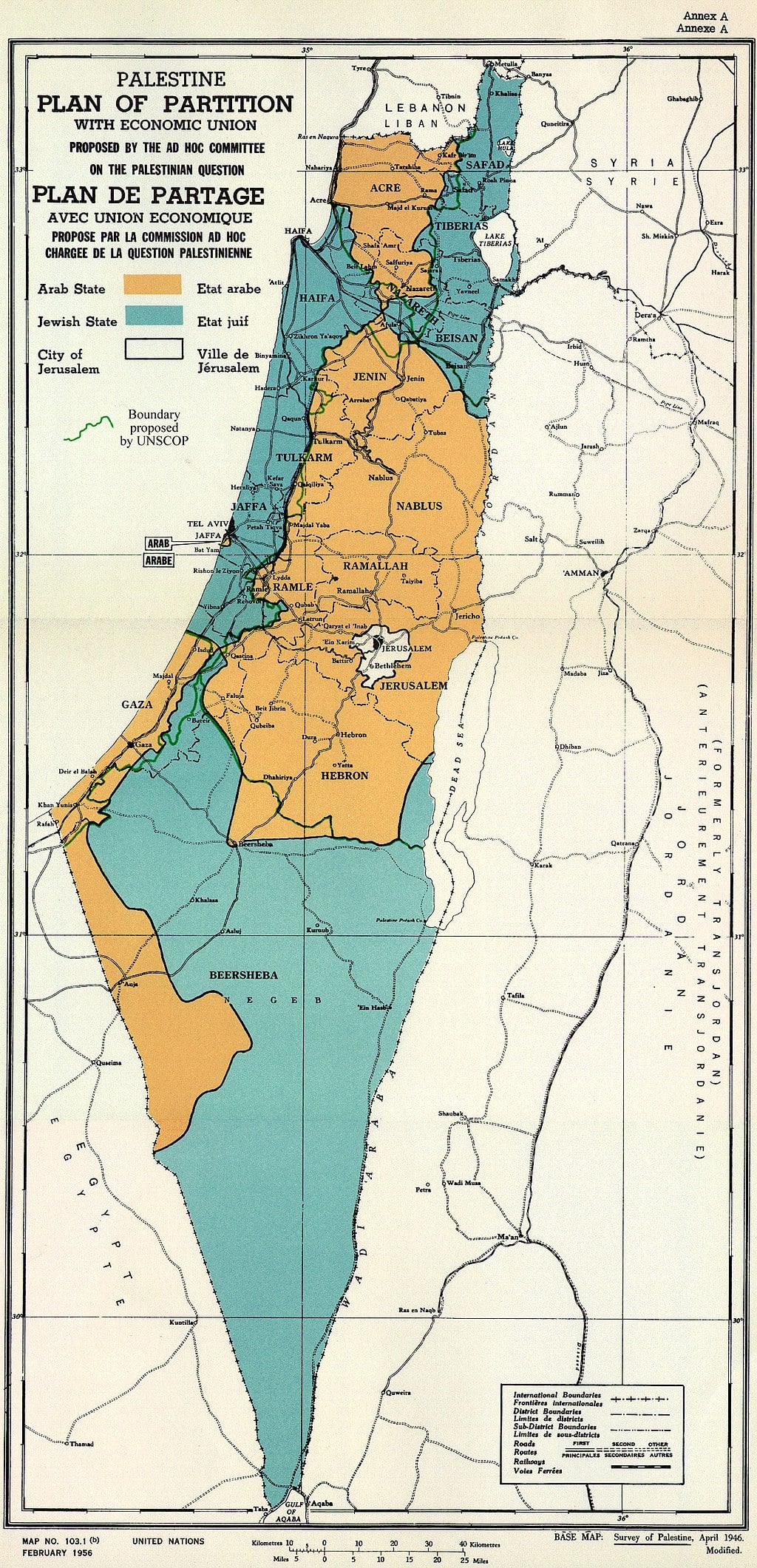
UN Partition Plan

The UN (United Nations) recommends the partition of Palestine into two states –­ one Jewish and one Arab, with Jerusalem staying under international control. The Jews accept the plan but the Arabs reject it.

Map of UN Partition Plan 1947

1947

1948

Gush Etzion Massacre

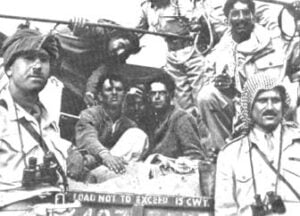
On May 13th ‘Kfar Etzion’ Kibbutz is attacked by the Arab Legion and local Arab men. Jewish Kibbutz residents and Haganah fighters defend themselves but on May 14th, the day that the state of Israel is proclaimed, they can no longer hold out, and surrender. 127 Jews are killed. This is why ‘Yom Ha’Zikaron’ is on May 13th annually.
Arab Legion Major Abdullah el Tell and Captain Hikmat Mihyar with two Jewish prisoners, May 14th 1948.
1948

1948

Israel Formed & War of Independence
The State of Israel is declared on May 14, 1948, according to the UN Partition Plan. The next day the newborn state is attacked by the armies of Egypt, Syria, Jordan, Iraq, Saudi Arabia and Lebanon as well as the Arab Liberation Army. Fighting lasts for eight months killing over 10,000 Arabs and over 6,000 Jews. Israel survives and ends up with an additional 2,500 square miles to what had been agreed in the Partition plan.

1948

1948–51

Wave of immigration

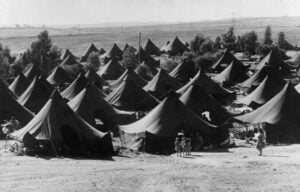
From 1948 to 1951, over 700,000 Jewish immigrants enter Israel. Most are Holocaust survivors or Jews fleeing from Arab lands.
Tents used as temporary housing for immigrants, 1950.
1948–51

1956

Suez Crisis

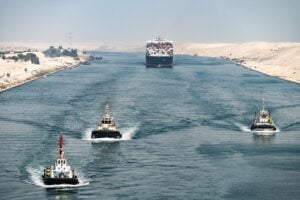
The Suez Canal is a vital passage for ships and trade. Egypt seizes control of the Suez Canal from the British and French. Israel, Britain and France attack Egypt to gain back control of the canal, but do not win.

1956

1961

Eichmann Trial

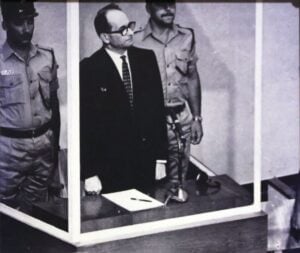
Israel captures Nazi leader and Holocaust perpetrator Adolf Eichmann in Argentina (where he was in hiding) and brings him to Israel to stand trial. This is televised internationally. He is convicted of 15 crimes by three judges. Eichmann is the only person sentenced to death by the Israeli courts.

1961

1964

PLO Formed

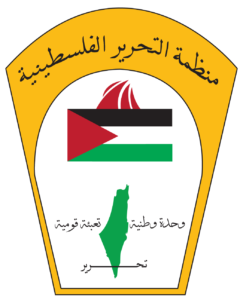
The Palestine Liberation Organisation (PLO) is formed as the official representative body of the Palestinian people. It initially wants to establish an Arab state covering the entire territory, totally eliminating the State of Israel. (However, since the 1993 Oslo Accords, the PLO only seeks Arab statehood in the West Bank and the Gaza Strip.)

PLO Logo

1964

1967

Six Day War

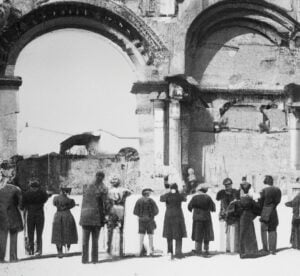
There are many attacks on Israeli civilians from Egypt, Jordan and Syria between 1965–67. Full scale war brakes out. By the end of the war Israel triples the size of the area it controls, including the Sinai, Old City of Jerusalem, Golan Heights, Gaza Strip and West Bank. For the first time in 19 years, Israeli Jews can visit the Western Wall.
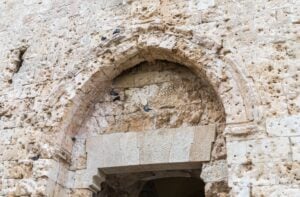
The Zion Gate (one of the seven entrances into the Old City of Jerusalem) covered in bullet holes from the Six Day War.
1967

1969

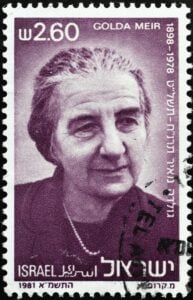
Golda Meir

Israel’s first and only female head of government (and the first in the Middle East) is elected. She serves as prime minister for five years.

1969

1972

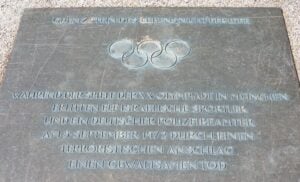
Munich massacre

During the 1972 Olympics in Munich, West Germany, a terrorist attack is carried out by the Palestinian terrorist organisation ‘Black September’. They kill two members of the Israeli Olympic team and take nine others hostage. The police kill five of the Black September members, but the rescue attempt fails and all of the hostages plus one police officer are killed.
German plaque to remember the dead.
1972

1973

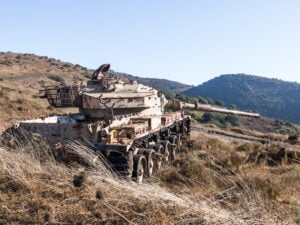
Yom Kippur War

Egypt and Syria launch a surprise attack on Israel on Yom Kippur – the Day of Atonement, the holiest day of the Jewish calendar. Approximately 2,500 Israelis and 15,000 Arabs die during the three-week conflict, which ends with an Israeli victory.
The remains of a tank from the Yom Kippur war.
1973

1978 & 79

Eurovision win

Israel enters the Eurovision song contest for the first time in 1973. Israel wins in 1978, so in 1979 hosts the competition and wins again! (Israel also wins in 1998 and 2018.)
1978 & 79

1979

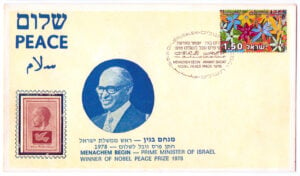
Peace Treaty With Egypt

Egyptian President Anwar Sadat and Israeli Prime Minister Menahem Begin work together and sign a peace agreement (facilitated by the United States). Egypt is the first Arab state to officially recognise Israel’s right to exist. Sadat and Begin jointly win a Nobel Prize for Peace.

1979

1982–85

Lebanon War

Following PLO attacks on Israel during an agreed ceasefire, Israel launches an attack on the PLO in Southern Lebanon – ‘Operation Peace for Galilee’. However, Christian fighters get involved and massacre hundreds of Palestinian civilians. This causes the world to condemn the operation and leads to the resignation of Israel’s Defence Minister Ariel Sharon following a huge public outcry in Israel. Despite Israel and Lebanon signing a peace agreement in 1983, unrest continues until 1985.
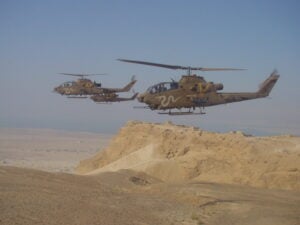
IAF Cobra gunships used during this war.
1982–85

1991

Gulf War

Without provocation, Iraq (led by Saddam Hussein) fires 42 Scud missiles at Israel, aiming to drag Israel into the war (in which several Arab countries are involved). Israel does not retaliate.

1991

1987–1995

First Intifada (Uprising) & Hamas formed

An Israeli vehicle in Gaza causes a crash that kills four Palestinians. This is perceived by Palestinians as an act of revenge for the murder of an Israeli in Gaza a few days earlier. This leads to protests and riots carried out by Palestinians. The unrest continues for nearly 6 years.

Hamas (an acronym of Harakat al-Muqawama al-Islamiya, meaning ‘Islamic Resistance Movement’) is founded (1987) as a political and military movement. It has controlled Gaza since 2007 and is proscribed by the British and American  governments as a terrorist organisation.
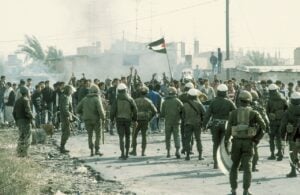
Gaza Strip, 1987. Photographer: Efi Sharir, Dan Hadani Archive.
1987–1995

1993 & 1995

Oslo Accords

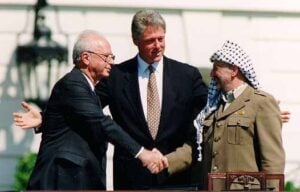
The first direct Palestinian-Israeli peace agreements are signed by Israeli Prime Minister Yitzhak Rabin and leader of the Palestine Liberation Organisation (PLO) Yasser Arafat, facilitated by the USA. These are supposed to be the first steps in creating a two state (split land and control) solution. Both leaders are awarded a Nobel Peace Prize.
1993 & 1995

1995

Yitzhak Rabin Assassination

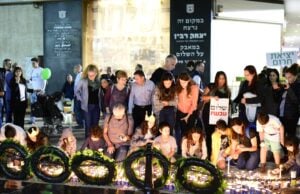
Prime Minister Yitzhak Rabin is assassinated by Israeli extremist Yigal Amir. Amir is a law student and ultranationalist who radically opposes Rabin working with Palestinian leader Yasser Arafat for peace.
Israelis light candles at the site of Rabin’s murder (now called Rabin Square).
1995

2000–2005

Second Intifada

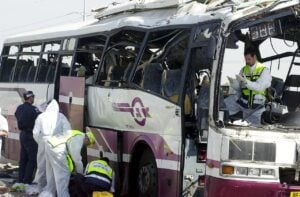
Likud political party chairman Ariel Sharon visits the Temple Mount. The next day widespread Palestinian violence towards Israel erupts in the Old City of Jerusalem, West Bank and the Gaza Strip. Over five years, terrorists target Israeli civilians on buses, restaurants and on city streets. Many people are killed on both sides.
The remains of an Israeli bus, bombed in 2002 by a Hamas (Palestinian) suicide bomber. Eight people are killed and 19 injured. (Zvika Golan c/o Wikipedia)
2000–2005

2013

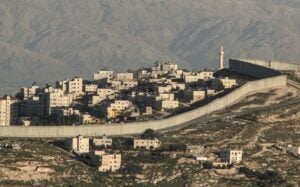
Security Wall

Israel builds the ‘West Bank barrier’ along the green line (border of the West Bank), following a wave of Palestinian political violence and incidents of terrorism inside Israel during the Second Intifada (uprising). Israel describes the wall as a necessary security barrier against Palestinian political violence, whereas Palestinians describe it as racial segregation.
2013

2021

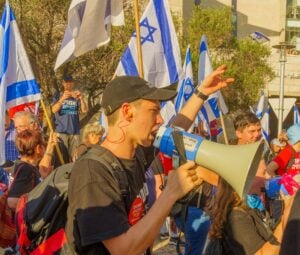
Constitutional Crisis

A period of political instability in Israel. An attempt is made by the right-wing Israeli government to restrict the independence of the courts. This leads to weekly protesting by hundreds of thousands of Israelis.

2021

2021

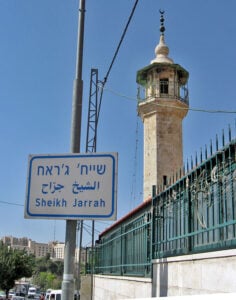
Israel-Palestine crisis

A major outbreak of violence occurs during May 2021. This is triggered by Palestinians protesting over an anticipated decision of the Israeli supreme court on the eviction of six Palestinian families in an East Jerusalem neighbourhood – Sheikh Jarrah. A ceasefire is agreed after two weeks.

2021

2023

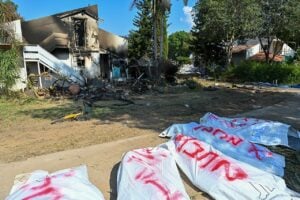
October 7 Massacre by Hamas

Hamas, a terrorist organisation (as proscribed by the British government) is the ruling power in Gaza. On October 7th, as well as firing rockets at Israel, 1,500 Hamas terrorists break through the border from Gaza into Israel.  Over 1,400 Israelis and foreign workers are attacked, raped and killed in horrendous ways at a music festival and in their homes. Whole families including babies are killed, houses burned down, and over 200 Israeli civilians (including children) are taken hostage. Israel mobilises its troops and goes into Gaza to fight Hamas. Tragically many civilians are killed in this process.

2023