
Synagogues
Torah scrolls are usually kept in a synagogue in a special cupboard at the front called the Aron HaKodeshThe special cupboard where Torah scrolls are kept, usually at the front of a synagogue. Meaning ‘Holy Ark’. (Holy Ark). In front of the Ark is a lamp called the Ner Tamid (Everlasting Light). It is similar to the menorahA seven branched candlestick that was lit everyday in the Temple. (seven-branched lamp) that was constantly lit in the TempleA huge complex that stood in Jerusalem. It was the centre of Jewish religious life from about 1200 BCE – 70 CE., showing that God is always present. The front of the synagogue is always built facing towards Jerusalem (facing east from the UK).
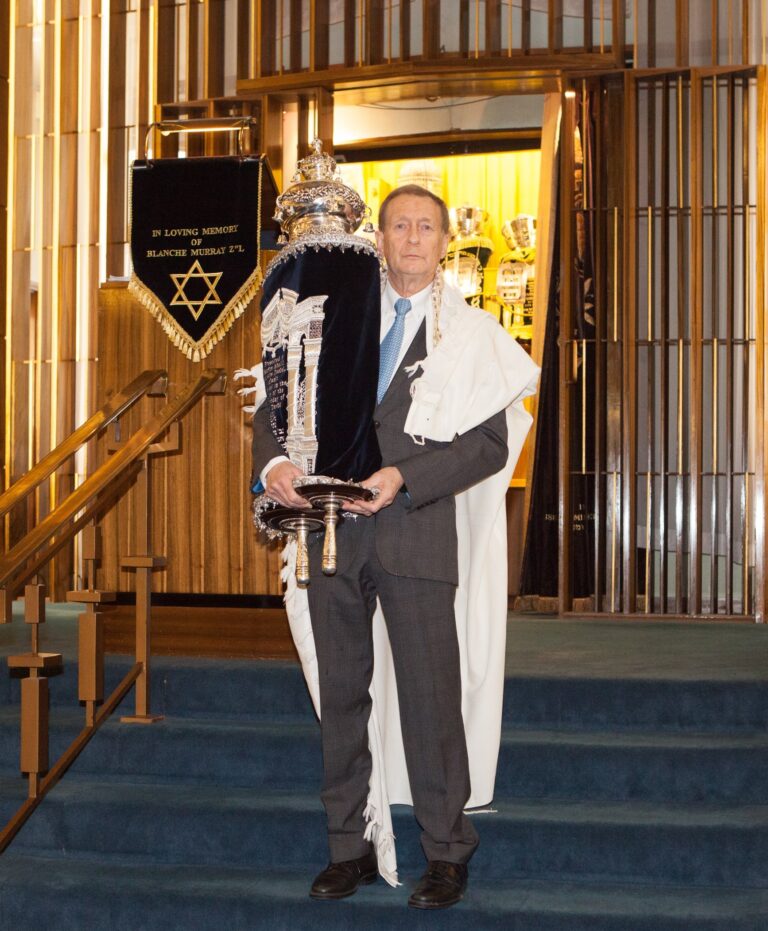
A chapter of the Torah is read out loud in synagogues each week on ShabbatThe Jewish sabbath day (Friday evening to Saturday evening). Sometimes pronounced ‘Shabbos’ by Ashkenazi Jews. and on many festivals. Orthodox and MasortiAn ideology within Judaism (see ‘Groups within Judaism’ page for more details). communities have public Torah readings on Monday and Thursday mornings as well.
The Torah is placed on a platform called the bimaSephardi name of the platform a Torah is placed on to read from it in a synagogue. (Ashkenazi
Jewish group and culture primarily developed around Central or Eastern Europe. name) or tebaSephardi name of the platform a Torah is placed on to read from it in a synagogue. (SephardiDescribes Jews of Spanish or Portuguese decent. name) to be read. In Orthodox and most MasortiAn ideology within Judaism (see ‘Groups within Judaism’ page for more details). synagogues, the platform is in the middle, facing the ark. In ReformAn ideology within Judaism (see ‘Groups within Judaism page for more details). and Liberal synagogues the platform is near the ark, facing the community.
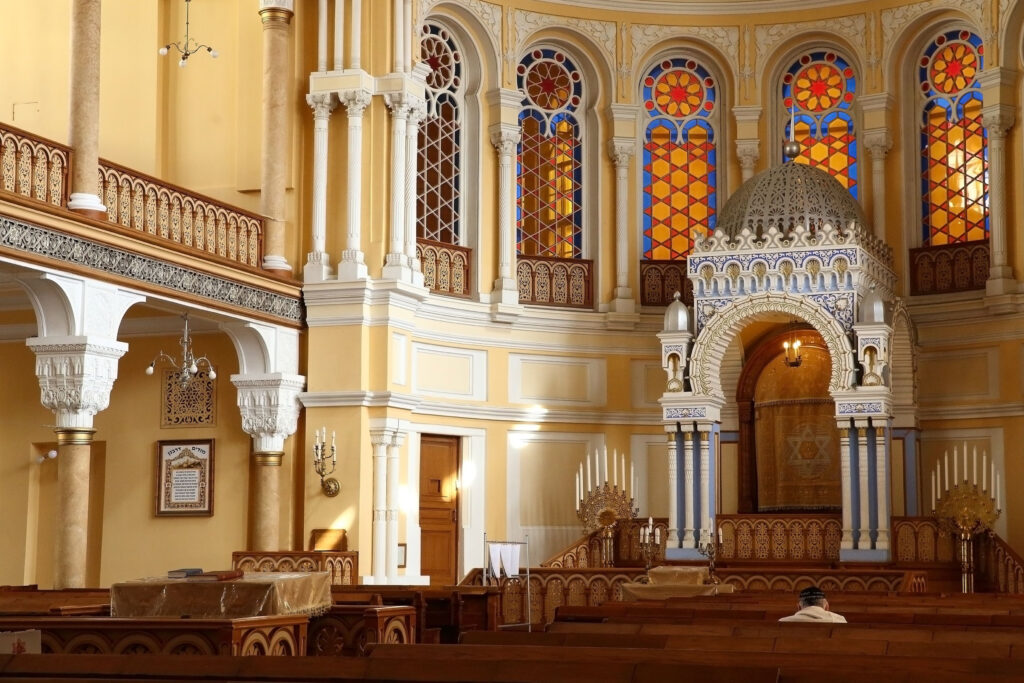
The Hebrew for synagogue is Beit KnessetThe Hebrew word for a synagogue, meaning ‘House of gathering’. (House of Gathering), as in addition to the prayer space it may include classrooms, a kitchen, a community centre or rooms for social events. Many Ashkenazi Jews use the Yiddish word shul (meaning ‘school’ due to gathering to learn Torah).
In Reform, LiberalAn ideology within Judaism (see ‘Groups within Judaism page for more details). and some Masorti communities, men and women sit together for prayer services. In Orthodox (and other Masorti) synagogues, men and women sit separately for prayer. Older synagogues were often built with a ‘ladies’ gallery’ upstairs and men’s seating downstairs. However in more modern buildings, men often sit on one side of the space and women on the other, often with a divider of some sort called a meḥitza.
Most prayers are said or sung in Hebrew and can be read from a siddurA Jewish prayer book. (prayerbook). The spiritual leader of a community is called a rabbiMeaning teacher. A spiritual leader of a community. Rabbis study for years and take the ‘smeiha’ exam to gain the title of rabbi.. This means ‘teacher’.
Traditionally most prayers are said in Hebrew but prayer in all languages are acceptable! Progressive communities use more English so be inclusive of those who cant speak Hebrew. The prayer that will always be said in English is the ‘Prayer for the Royal Family‘.
There are traditionally three prayer times each day: Shaḥarit – morning, Minḥa – afternoon and Ma’ariv (Ashkenazi name) or Aravit (Sephardi name) – evening. There is an extra, fourth prayer service for the afternoon for Shabbat. The exact timings for these vary according to season and daylight hours.
Prayer services can be led by a rabbi, ‘ḥazan’ (cantor) or any competent adult member of the community. Orthodox Judaism does not allow female rabbis. It also does not allow females to lead prayer services but the other groups/denominations do. (This is because, according to Orthodoxy, men have an obligation to pray at certain times, which women don’t, and include some specific prayers that women are not obligated to say. Therefore women cannot lead certain prayers which they are not required to say. Some also believe that women singing in front of men is immodest.)
TO FIND OUT
1. What language is the word ‘synagogue’ and what does it literally translate as?
2. What is a minyanA group of 10 or more people gathered for prayer.? How does a minyanA group of 10 or more people gathered for prayer. differ in OrthodoxOne of the major branches of Judaism. and non-Orthodox communities?
CRITICAL THINKING
1. Jewish people don’t need synagogues as we can pray anywhere. Why then do you think it is seen as preferable to get together as a community to pray, rather than pray alone at home?
2. Synagogues are not allowed to contain pictures of God. Why do you think there is a TorahThe Jewish holy book (bible). law not to make pictures or physical representations of God?
3. If you believe in God or a higher power, do you think a picture or physical representation of God helps you to think of God or pray, or in your mind, is God totally ‘formless’ – a force or power with no physical representation?
DID YOU KNOW?
1. Synagogues were created after the destruction of the Temples, when most Jews were forced to live outside of Israel. They needed to create an alternative space to gather for special occasions and religious activities, so synagogues were born.
2. Over half (57%) of British Jewish adults are members of a synagogueJewish communal building where people gather to pray, learn and celebrate. (From Greek – meaning place of gathering). (JPR survey, 2024).
3. 27% of British Jews attend synagogueJewish communal building where people gather to pray, learn and celebrate. (From Greek – meaning place of gathering). once a week or more. 27% never attend synagogueJewish communal building where people gather to pray, learn and celebrate. (From Greek – meaning place of gathering).. 15% attend only on Rosh HaShanaThe Jewish new year. (Literally translates as ‘Head of the year’.) and Yom KippurThe day of atonement. An annual date set by the Torah. (JPR survey, 2024).
4. The word ‘worship’ is generally not used in Jewish culture (apart from occasionally in Progressive communities). Terms like ‘prayer’, ‘prayer services’, as well the HebrewThe language of the Jewish people and of Israel. Hebrew is also used more generally to mean the culture of the Jewish people (ie. Hebrew calendar). word ‘tefilla’ (prayer) and the YiddishThe Ashkenazi Jewish language using German, Hebrew and Slavic words. word ‘davening’ (praying) are generally used.
CHECK YOUR KNOWLEDGE
1. What is a Ner TamidAn ‘everlasting light’ – left on continually in a synagogue, often near the ark, to represent God’s continual presence.?
2. Which direction do synagogues face and why?
3. Do men and women sit together in synagogues?

