
Torah Scrolls
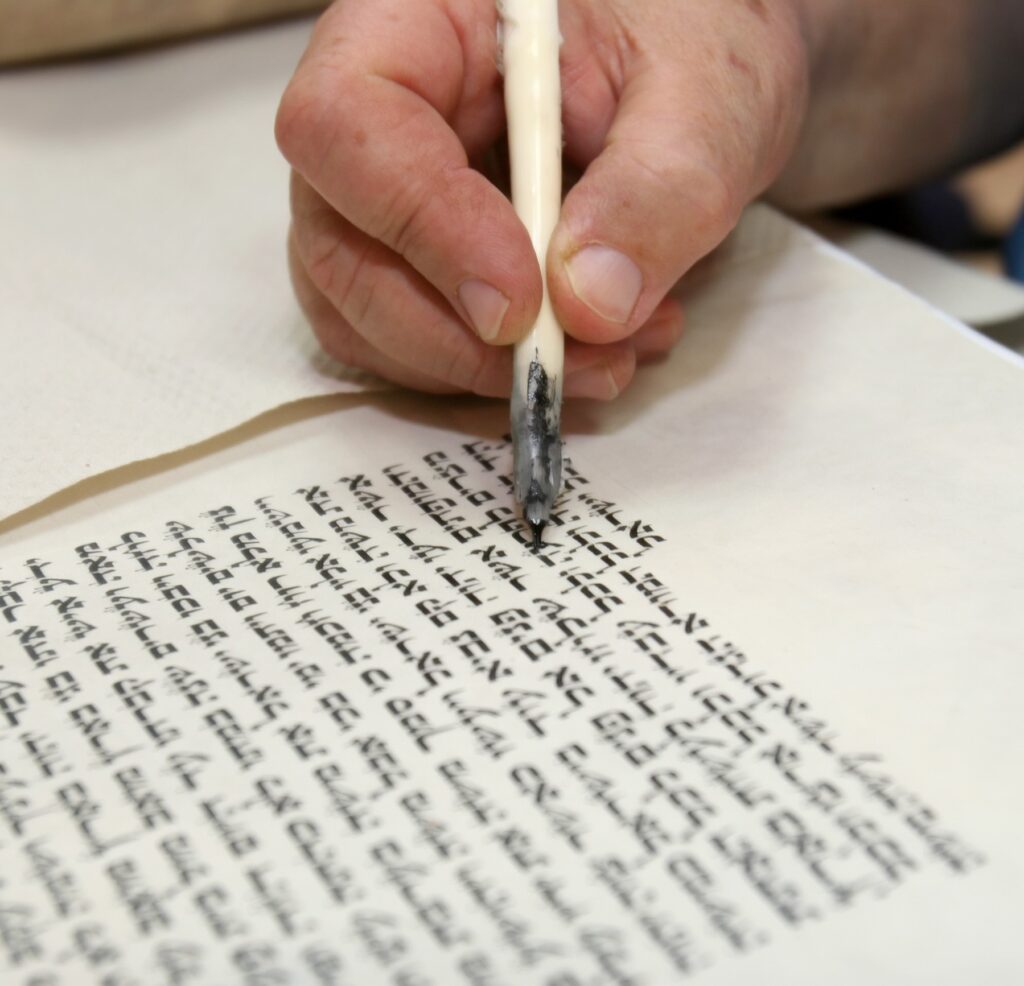
Torah scrolls are still made in exactly the same way they have always been – written in HebrewThe language of the Jewish people and of Israel. Hebrew is also used more generally to mean the culture of the Jewish people (ie. Hebrew calendar). by hand, by a ‘sofer’ (scribe), using a quill and special ink, on parchment (animal skin). Most Ashkenazi scribes use a feather quill pen, whilst most Sephardi scribes use a more ancient type of quill pen made from a reed. This is a long and delicate process and it takes at least a year to create a full scroll. It is considered disrespectful to erase the name of God, so if a scribe makes a mistake on certain words, they have to start that whole section again!
There is no punctuation and no vowel notation marks (little markers which normally appear around HebrewThe language of the Jewish people and of Israel. Hebrew is also used more generally to mean the culture of the Jewish people (ie. Hebrew calendar). letters) in a Torah scroll, so people who want to read from a scroll have to learn how to and practise.
In most synagogues you will find printed copies of the Torah in book format (usually with both punctuation and translation) called a ḥumash so people can follow along easily.
Torah scrolls are kept in a special cupboard at the front of the synagogue called an Aron Hakodesh (holy ark). In some countries Torah scrolls have soft, fabric covers, and in others they have hard, rounded cases.
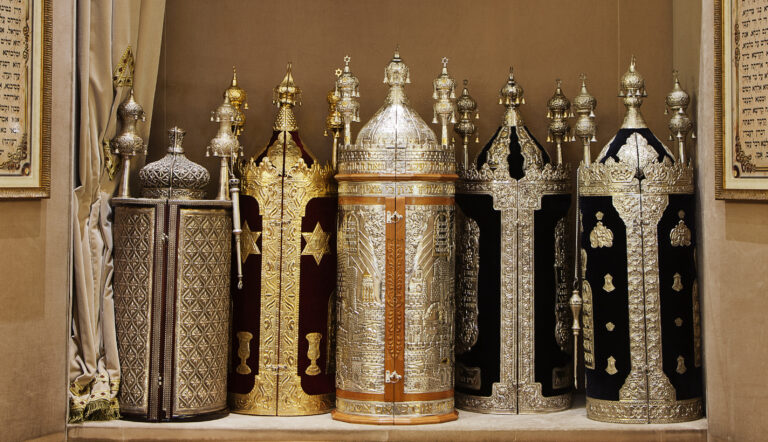
They are decorated with beautiful covers and sometimes silver and gold decorations, including a yad (hand) used as a pointer to follow the text. People do not touch the writing with their fingers – not only to keep the Torah scroll clean, but also as a sign of respect.
Jewish communities read a chapter of the Torah in synagogue every week, (and on some festivals) so that every year, the entire Torah is read. (In some Progressive communities the cycle of reading the whole Torah is every three years.)
Finishing reading the whole Torah is celebrated by a festival called Simḥat TorahA festival in Autumn, celebrating completing reading the whole Torah, and starting again at the beginning. (Rejoicing of the Torah) in the autumn. Part of the ceremony is to roll the whole Torah scroll back to the beginning, to be read again!
TO FIND OUT
1. TorahThe Jewish holy book (bible). laws are divided into two categories: ‘mishpatim’, where there is clear or logical reasoning behind them; and ‘ḥukim’, which are laws that are much harder to understand and may not seem to have any logic behind them. Can you find an example of each?
2. Why do some Jewish people prefer to write the English word ‘God’ as ‘G-d’?
3. Next to the holy ark in a synagogueJewish communal building where people gather to pray, learn and celebrate. (From Greek – meaning place of gathering)., there is a light called the ‘Ner TamidAn ‘everlasting light’ – left on continually in a synagogue, often near the ark, to represent God’s continual presence.‘ (everlasting light). Why is the ner tamidAn ‘everlasting light’ – left on continually in a synagogue, often near the ark, to represent God’s continual presence. different from other lights in the synagogueJewish communal building where people gather to pray, learn and celebrate. (From Greek – meaning place of gathering).? What does it represent? How is it connected to something that used to be in the Jewish TempleA huge complex that stood in Jerusalem. It was the centre of Jewish religious life from about 1200 BCE – 70 CE.?
CRITICAL THINKING
1. Why are new Torah scrolls still created by hand when it is so time-consuming and difficult?
2. Why do you think there is no punctuation in a Torah scroll?
DID YOU KNOW?
1. When the Torah is read in public, it is sung using specific tunes which set the mood of what is being read. Ashkenazi
Jewish group and culture primarily developed around Central or Eastern Europe. and SephardiDescribes Jews of Spanish or Portuguese decent. tunes vary slightly.
2.When a new Torah is created, it is celebrated with a ceremony, beginning with the writing of the last letters of the scroll. The scroll is then carried in an outdoor procession, usually under a canopy (like a wedding canopy) to the synagogue or place where it will be kept, accompanied by singing, dancing, and sometimes music.
CHECK YOUR KNOWLEDGE
1. What are Torah scrolls made from and what are they written with?
2. Describe what you might find covering and decorating a Torah scroll.
3. What type of punctuation or symbols would you find in a Torah scroll?

